Buddhadharma and Meditation
I have been practising the Dharma since 2007, mostly in the Insight Meditation tradition. My primary teacher is Rob Burbea (1965 - 2020), with whom I worked on emptiness and samadhi. I have also practiced in the Dzogchen tradition with Tsoknyi Rinpoche, the Mahasi tradition with Carl Fooks, and the Headless Way with Richard Lang.
Guided Meditations and Dharma Talks
Below are some recordings of Guided Meditations and short Dharma Talks that I have offered at Gaia House’s Online Dharma Hall in my capacity as a Community Dharma Leader (CDL).
These recordings are offered freely in the spirit of dana (generosity). If you would like to ‘pay it forward’ and support me to offer more Dharma in the future, you can do so here: paypal.com/paypalme/andywimbush
Questions? Issues? Please contact me.
Unfindable Mind
5 September 2026
(You may like to listen to “Faith in Mind” before this session.)
We spend a lot of time in meditation preoccupied with consciousness/awareness/mind. But is mind actually a thing that we can find?
What would happen if we were to cultivate a beautiful open awareness, like a vast sky, and then attempt to find awareness? Is there a greater freedom available in a mind that is unfindable, empty, and without any nature of its own?
Faith in Mind
30 August 2026
The Xinxin Ming (信心銘) - “Faith in Mind” - is a Chinese Zen classic that points directly to our awake nature. This talk and guided meditation explore how we can come to attune to and trust this boundless, empty capacity for all experience, beyond preference, reactivity, and self-judgement.
(You may like to listen to “Unfindable Mind” after this session as it continues to develop the investigation.)
The Practice of Not-Self (Anattā)
5 July 2026
The teaching of “not-self” (anattā) is one of the core tenets of Buddhism. While it can seem like statement of doctrine, the Buddha often taught it as a liberating way of looking that can be cultivated in meditation for insight, freedom, and ease.
Boundlessness and Love
14 June 2026
The Buddha recommends “suffusing the entire world and all of space with a heart and mind filled with good will". This talk and guided meditation explores playing with our perception of space and solidity to cultivate an open, non-obstructed spaciousness that is effortlessly warm, friendly, and open-hearted.
Dhammavicaya and Wonder
10 May 2026
The Buddha lists dhammavicaya - investigation of phenomena - as the second of his Seven Factors of Awakening. In this talk and guided meditation, I explore how we can foster curiosity and wonder by contemplating the unfindability of past and future and through the playful use of a Korean Zen koan: ‘What is this?’
Guanyin: The Bodhisattva of Compassion
4 April 2026
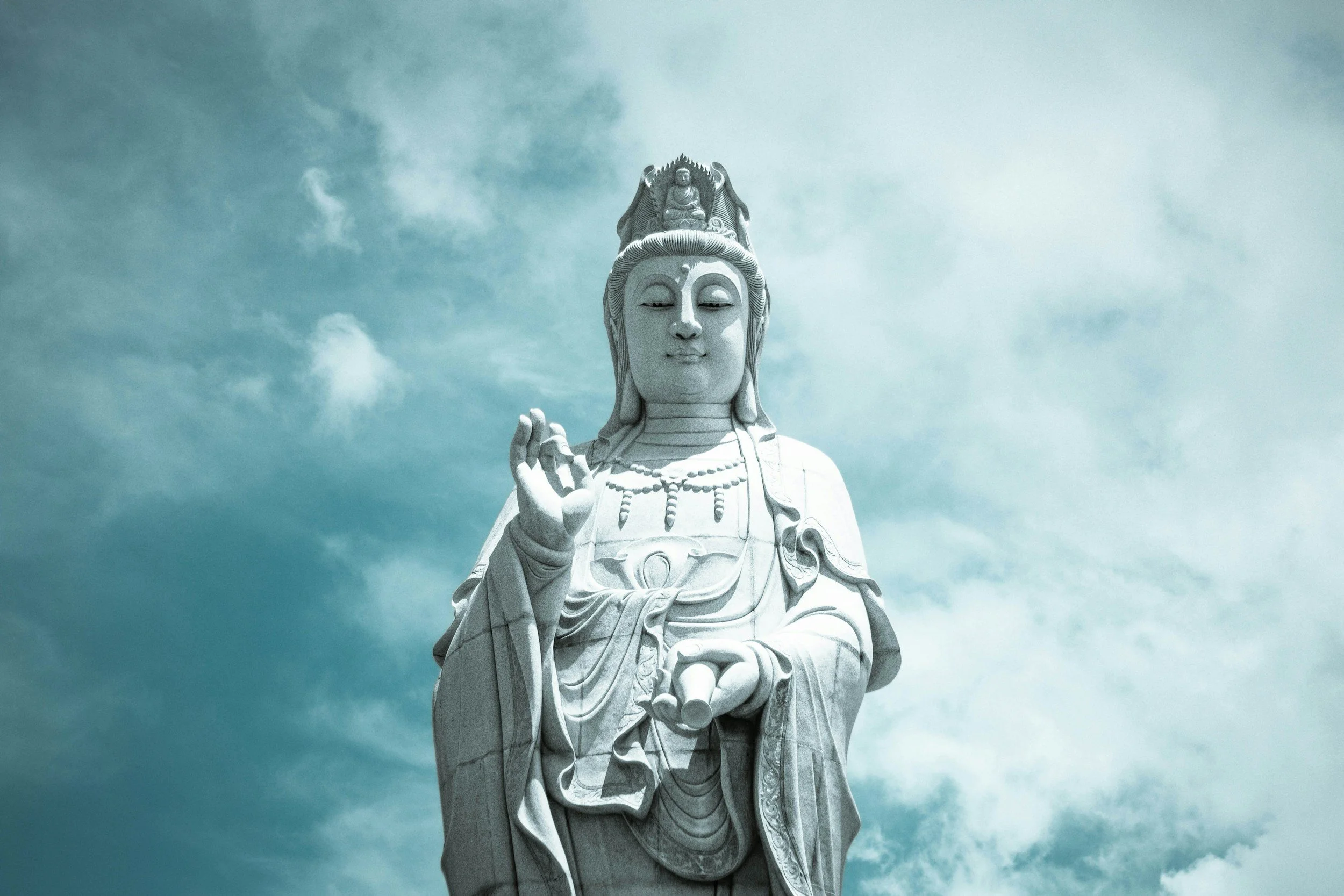
Guanyin is the Chinese version of the Mahayana Bodhisattva of Compassion whose name means ‘the one who listens to the sounds of the world.’ The talk and guided meditation explores how Guanyin can be approached as an inspiring archetype for compassion, as a prompt for an open listening practice, and as a non-dual pointer to the empty and centreless nature of awareness.
In the recordings, I quoted two haiku about Guanyin (referred to here by her Japanese name, Kannon). The English translations are mine.
The first is by Kobayashi Issa (1763–1828)
観音の
あらん限りは
桜かな
Kannon no
aran kagiri wa
sakura kana
wheresoever
in Kannon's boundless dwelling:
cherry blossoms...
The second is by Itō Michiaki (1935–2015)
冴返る
仏に千手
われに二手
sae-kaeru
hotoke ni sente
ware ni ni te
cold snaps back again —
Kannon has a thousand hands,
I have just these two
Intention and the Fantasy of Practice
11 October 2025
The Buddha frequently talks about the power of intention to transform the mind. We can harness this power through a skilful cultivation of ‘fantasy’ about the spiritual path and experiment with viewing our practice in different ways: as a journey of healing, artistry, discovery, service, and even enjoyment.
The Bahiya Sutta
12 July 2025
The Bahiya Sutta is an extremely radical teaching from the early discourses that points directly to the nondual nature of experience, right here, right now.
Appearances
24 May 2025
According to the Buddha, all appearances are unsatisfactory (dukkha). But then he also says that appearances are ‘the All’, with nothing apart from them. Can we find a refuge that is neither in appearances nor apart from them?
Welcoming
29 April 2025
In the Agara Sutta, the Buddha compares bodily experience to a guest house that receives different kinds of visitors: unpleasant, pleasant, and neither. What if we were take this comparison as a meditation instruction and actively welcome all phenomena in a hospitable manner?